Carnet / Loire, Dordogne & Auvergne
RegionCentre-Val de LoireBy railTrain from Paris Austerlitz to Blois or Amboise
The Loire châteaux: Chambord, Blois, Amboise and Chenonceau
A route through royal staircases, an immense walled park and a château spanning the Cher on arches.
 Carsten Steger • BY-SA 4.0
What should the Loire explain first: its staircases, its kings, or its rivers?
UNESCO inscribed the valley between Sully-sur-Loire and Chalonnes in 2000. This itinerary gives each stop time to explain its own particular mechanism: Blois through a staircase, Chambord through scale, Amboise through its royal and artistic history, and Chenonceau through its arches.
The numbers: begun in 1519; about 5,440 hectares; about 32 kilometres; about an hour and a half by train to Blois.
Trains from Paris Austerlitz reach Blois in about an hour and a half. The fact box also names Amboise as a rail destination from Paris Austerlitz. Keep the route’s rhythm simple: give the places room, rather than trying to turn every stop into a hurried transfer.
Blois
Morning. Begin at Blois, where the Château de Blois makes the staircase the first lesson. Its François I wing has a famous open spiral staircase. You can read the structure from outside: a turning route, left visible rather than tucked away.
At Blois, the staircase makes movement part of the architecture.
At Blois, the staircase makes movement part of the architecture.
Midday. Stay with that idea instead of treating the staircase as decoration. A spiral controls how people move through a building; an open one also lets you see that movement. The detail is specific, and that is the pleasure here: the château gives you something concrete to look at, not just a royal name to remember.
Late afternoon. Set the building beside the valley around it. The Loire’s World Heritage inscription covers the stretch between Sully-sur-Loire and Chalonnes, so the story belongs to more than individual façades. The river gives the châteaux a wider frame. Let that be your map for what comes next.
Chambord
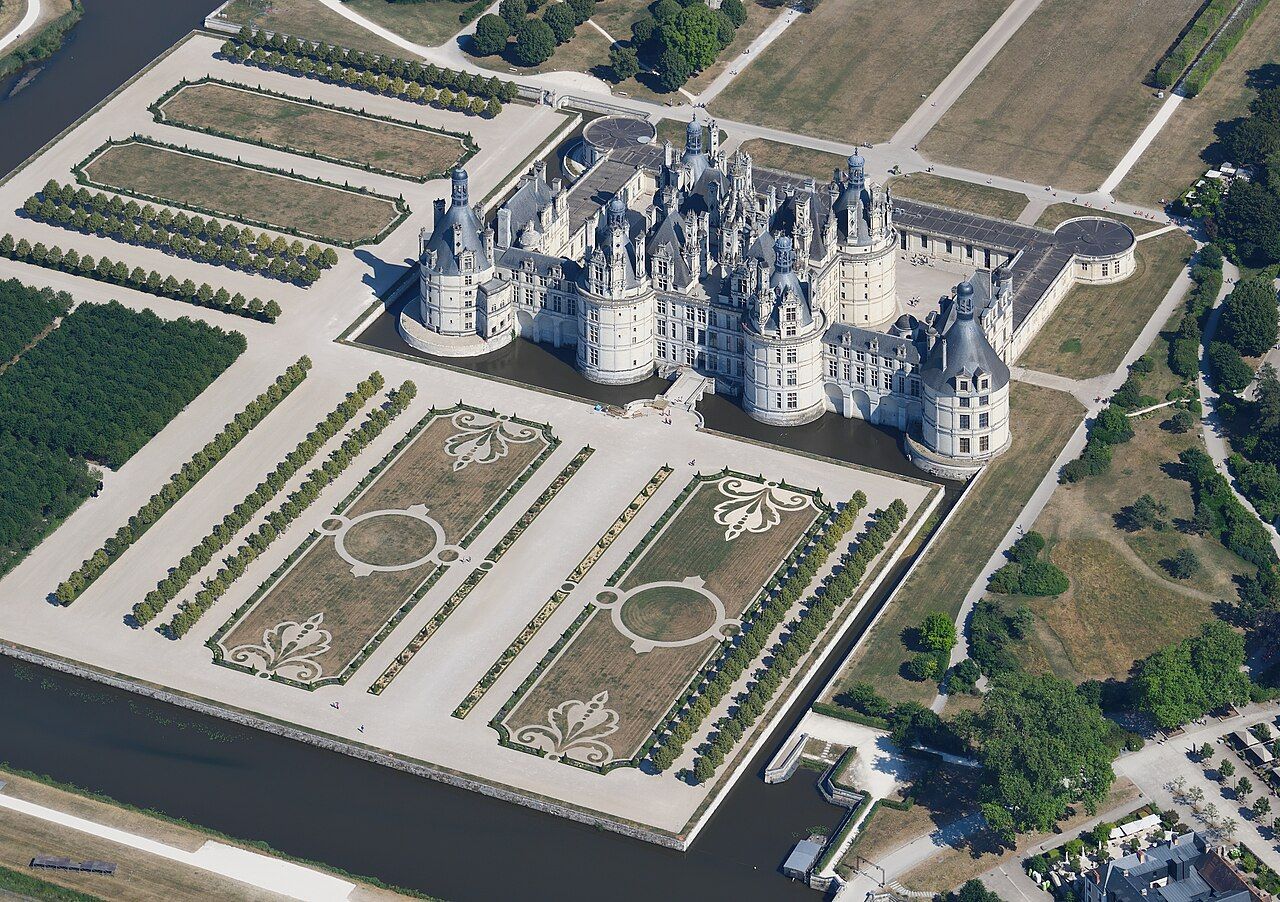
Morning. Give Chambord a day of its own. The Château de Chambord was begun in 1519 for King François I. That date is a useful anchor: you are looking at a royal project with a precise beginning, not an anonymous château from some misty past.
Inside, find the double-helix staircase. Two people can climb at the same time without meeting. The design turns a practical problem into the building’s clearest trick: two rising paths, held together in one staircase, without crossing. You can follow the logic with your eyes before deciding which route you would take.
Midday. Then shift your attention from the staircase to the park. Chambord’s walled park covers about 5,440 hectares, enclosed by a wall about 32 kilometres long. Those figures change your sense of scale. The château is not the whole story; its enclosed ground is part of the design, too.
That is a useful contrast with Blois. One makes a staircase visible; the other pairs a clever stair with an enormous boundary. If you want another way to think about movement through the river landscape, try cycling the river's levees. Keep your attention on what each route reveals: structure, scale, or the shape of the valley.
Late afternoon. Leave the details in your head rather than forcing another comparison. A double helix is easy to recall; a walled park measured in thousands of hectares is harder to picture. Together, they make Chambord a place where the building and its grounds insist on equal attention.
Amboise
Morning. At Amboise, begin with the château’s position. The Château d'Amboise stands on a spur above the Loire. That elevated setting gives you a clean relationship to read: the château above, the river below. The landscape is not merely a backdrop; it explains where the building sits.
Amboise also brings a different kind of history into the itinerary. Leonardo da Vinci spent his last years here and died in 1519. He is believed to be buried in the chapel of Saint-Hubert at the Château d'Amboise. Hold on to the distinction: his burial there is believed, not stated as certain.
Midday. Take time with that connection rather than piling on extra claims. The château joins a royal setting to the final years of an artist, and the chapel gives that story a specific place. You do not need a long list of names when one carefully placed detail does the work.
Late afternoon. Bring the Loire back into view. At Blois, you met a visible spiral; at Chambord, two paths that do not meet; here, a château on a spur above the water. Three different ways for buildings to explain movement, position and power.
Chenonceau
Morning. Make Chenonceau the last stop in this sequence. The Château de Chenonceau spans the river Cher on a gallery of arches. The building does not simply stand beside the water; its gallery crosses over it. That is a striking piece of engineering to carry into the final day.
Chenonceau is often called the château of the ladies because women shaped it, including Diane de Poitiers and Catherine de' Medici. The name makes the story’s emphasis plain. Here, the history is not only about kings and royal building projects; women’s influence belongs in the description of the château itself.
Midday. Look at the arches and then the gallery they support. The simple relationship is the point: a passage held above a river, making the crossing part of the architecture. Against Chambord’s vast walled park and Amboise’s raised position, Chenonceau gives you a more direct meeting of building and water.
Late afternoon. Finish with the river as your thread, not a checklist. Blois gives you its open spiral, Chambord its double helix and immense enclosure, Amboise its spur above the Loire, and Chenonceau its gallery over the Cher. The châteaux make different arguments; the rivers keep them in the same conversation.
Photos in this piece: TCY • BY-SA 4.0; Raimond Spekking • BY-SA 4.0; Another one of my pictures: This photograph was taken by Medium69 (Wil • BY-SA 4.0