Carnet / Loire, Dordogne & Auvergne
RegionCentre-Val de Loire and Pays de la LoireBy railTER along the valley; bikes carried
La Loire à Vélo: a week on the levées
Ride the signposted route between Tours and Angers in a steady rhythm: follow the levees downstream, pause at midday, and keep the TER in reserve.
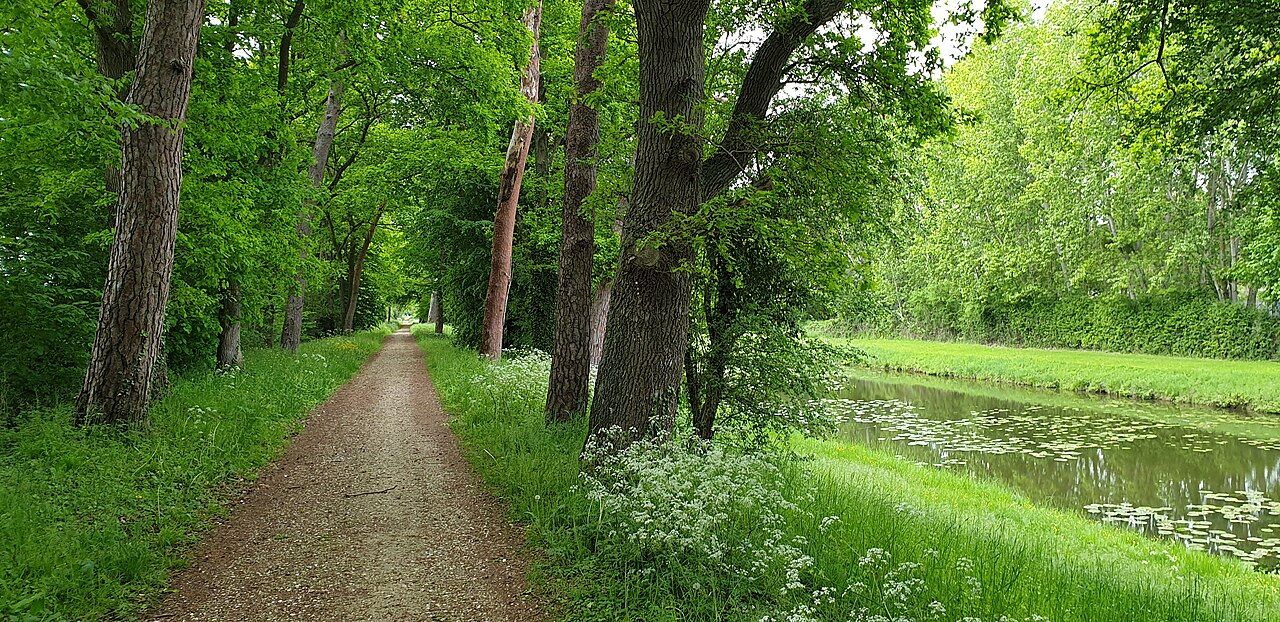 TCY • BY-SA 4.0
Could a week on the Loire be measured by its levees? Between Tours and Angers, let the river set your pace. La Loire à Vélo is signposted, mostly flat, and built for riding downstream.
The numbers: about 900 kilometres from Cuffy to Saint-Brevin-les-Pins; the Loire itself is about 1,000 kilometres long.
That full route forms part of EuroVelo 6, from the Atlantic to the Black Sea. You only need to think about one stretch here: Tours to Angers, with the train as your useful backup.
Tours
Morning. Start by noticing what the route rides on. Much of La Loire à Vélo follows the tops of levées, the raised banks built to hold back the river's floods. The route’s flatness has a reason, too: it follows the valley downstream.
That engineering makes a fine companion for a week. You can keep your attention on the river’s course, not on a succession of climbs. The Loire is often called France’s last wild river, because long stretches have no dams. The name points to a mechanism, not a mood.
If castles draw you off the line, plan around the royal châteaux along the river. But don’t turn every ride into a detour. The levées are the story here: practical banks that became a route for seeing how the river valley works.
Saumur
Midday. Use the middle of the day to pause your riding rhythm. Keep the itinerary loose: this is a week in stages, not a race to cover the route’s full length. Saumur lies on or close to La Loire à Vélo, giving your route a natural point to think about the next stretch.
There is a pleasing bit of scale to hold in mind. The Loire is the longest river entirely in France, and the cycle route follows it for about 900 kilometres. You are riding one portion of a much longer line, part of a route that links the Atlantic with the Black Sea.
Late afternoon. Let the river valley keep doing the navigation. The route is signposted, and the levées make its shape legible: raised banks, flood protection, and a long, mostly level way downstream. I’d skip the urge to make every pause productive. Sometimes the useful thing is simply not pedalling for a while.
Angers
Morning. Ride towards Angers with the train option already in your plan. Many regional TER trains in the Loire valley carry bicycles, so you can ride one way and return by rail. That takes the pressure off making a loop, and makes the week easier to shape in stages.
For the train part, start with how French trains fit together. Keep the distinction clear: the ride follows the river valley; the TER gives you a way back. The fact that bikes are carried turns a linear route into a practical choice, not a logistical puzzle.
Midday. Angers, like Tours and Saumur, lies on or close to the route. Use it as the end of this stretch, rather than pretending the whole 900 kilometres fit into a week. You have followed one river corridor and learnt what holds its banks in place.
Late afternoon. If your mind wanders further downstream, the Loire meets the Atlantic at Saint-Nazaire. A bridge more than 3 kilometres long crosses the estuary there. That’s a different scale of crossing from a week on the levées, but the river keeps supplying the engineering lesson.
Ride the banks, take the train back, and call it a loop. The Loire may object, but it has no wheels.
Photos in this piece: Raimond Spekking • BY-SA 4.0; Another one of my pictures: This photograph was taken by Medium69 (Wil • BY-SA 4.0; Dietmar Rabich • BY-SA 4.0