RegionÎle-de-France (Paris 5e)By railRER B or C to Saint-Michel Notre-Dame
The Latin Quarter on foot: the 5th arrondissement
Walk from the Sorbonne and the Panthéon to Roman Lutèce and the Jardin des Plantes, with two thousand years of Paris layered along the way.
 Maksim Sokolov (maxergon.com) • BY-SA 4.0
How many layers of Paris can you follow on one walk?
In the 5th arrondissement, the answer stretches across two thousand years. You move from medieval university life to Roman stone, then medicinal plants. The Latin Quarter takes its name from students speaking Latin. That language belonged to the medieval university, not just its books.
The numbers: 1257; 1790; 1851; 1st century AD; 17th century.
Sorbonne
Morning. Begin with the Sorbonne, whose history reaches back to 1257. That was when Robert de Sorbon founded a college. You are not just crossing an old university district. You are following the reason the area has its name.
Latin was the students’ spoken language at the medieval university. Keep that detail in mind as you walk. The quarter’s name records a working language, not a Roman settlement. The Roman layer comes later on this route, in stone and street lines.
From the Sorbonne, continue towards the Panthéon. The walk gathers two different kinds of memory. One begins with a college; the other began as a church. You can read each place through the purpose it first served.
Panthéon
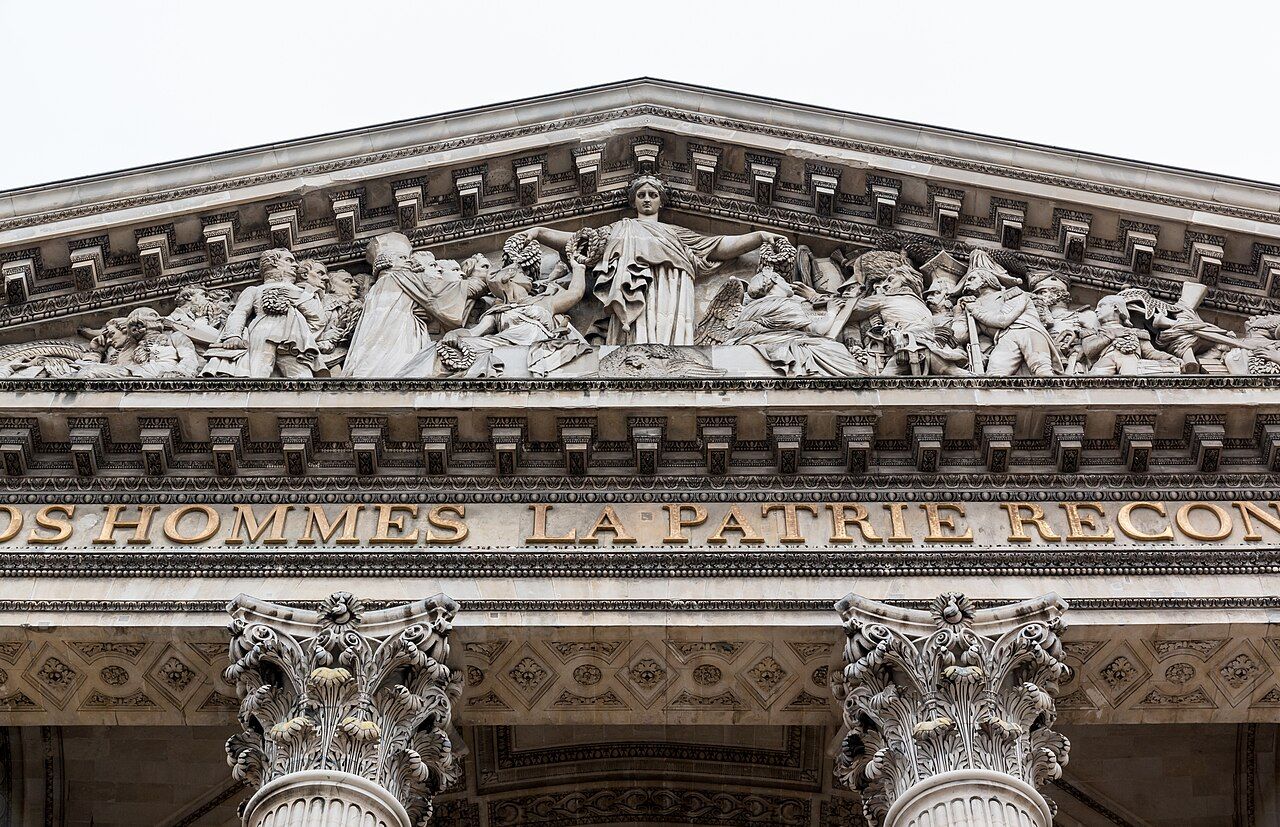
The Panthéon was begun as a church dedicated to Sainte-Geneviève. It was completed in 1790. The change from church to a place holding national figures gives this stop its particular weight. Its tombs include Voltaire, Rousseau, Victor Hugo and Marie Curie.
There is also a working demonstration hidden in the building’s history. In 1851, Léon Foucault demonstrated the Earth’s rotation with a pendulum hung here. The mechanism makes an immense idea visible. You do not need a complicated detour to connect this building with science.
Midday. Give the route room for another medieval layer: the Musée de Cluny. It is the national museum of the Middle Ages. The Lady and the Unicorn tapestries are kept here. That pairing is useful: one name tells you the period, the other gives you something specific to hold in mind.
 Dietmar Rabich • BY-SA 4.0
If you want another walk built around old Paris, try the steep lanes of the 18th. For this itinerary, keep your attention on how the 5th layers different periods close together.
Rue Mouffetard
Rue Mouffetard gives you a street with a much older line beneath it. Rue Mouffetard is counted among Paris's earliest streets and follows the line of a Roman road. That is the satisfying bit: the modern street still traces an ancient direction. You are reading history through the shape of a route.
Don’t treat the Roman past as only a set of ruins. Here, it survives as a line through the city. The street makes the point without needing a grand monument beside it.
Arènes de Lutèce
Late afternoon. Continue down towards the Arènes de Lutèce. These are remains of a Roman amphitheatre from the 1st century AD. Today, the site is a public square. The shift in use is the story: a Roman structure remains part of everyday public space.
After the Panthéon’s tombs and Foucault’s pendulum, this is another way to meet the past. You can see the ancient layer not as an abstract date, but as a place with a present use. That keeps the walk grounded in Paris, rather than turning it into a list of eras.
Jardin des Plantes
Finish at the Jardin des Plantes, founded in the 17th century as a royal garden of medicinal plants. Its original purpose joins the walk’s themes neatly: knowledge, collected and put to use. From university Latin to medicinal plants, institutions have shaped this part of Paris.
RER lines B and C stop at Saint-Michel Notre-Dame, on the northern edge of the Latin Quarter. You can use that as your starting point, then follow the walk towards the Panthéon, the Roman arena and the garden. The route does not flatten the centuries into one story. It lets you notice how each one left a different kind of mark.
That is the pleasure of this 5th arrondissement walk: you keep changing the scale. A college gives way to a building, a pendulum, a street and a garden. Paris does the layering; you supply the walking.
Photos in this piece: Dietmar Rabich • BY-SA 4.0; Benh LIEU SONG • BY 2.5; Jörg Braukmann • BY-SA 4.0