RegionÎle-de-France (Paris 18e)By railMetro line 12 to Abbesses
Montmartre: climbing Paris’s village hill
From Abbesses, climb towards Sacré-Cœur, then let the old village square and a small hillside vineyard explain what Paris absorbed.
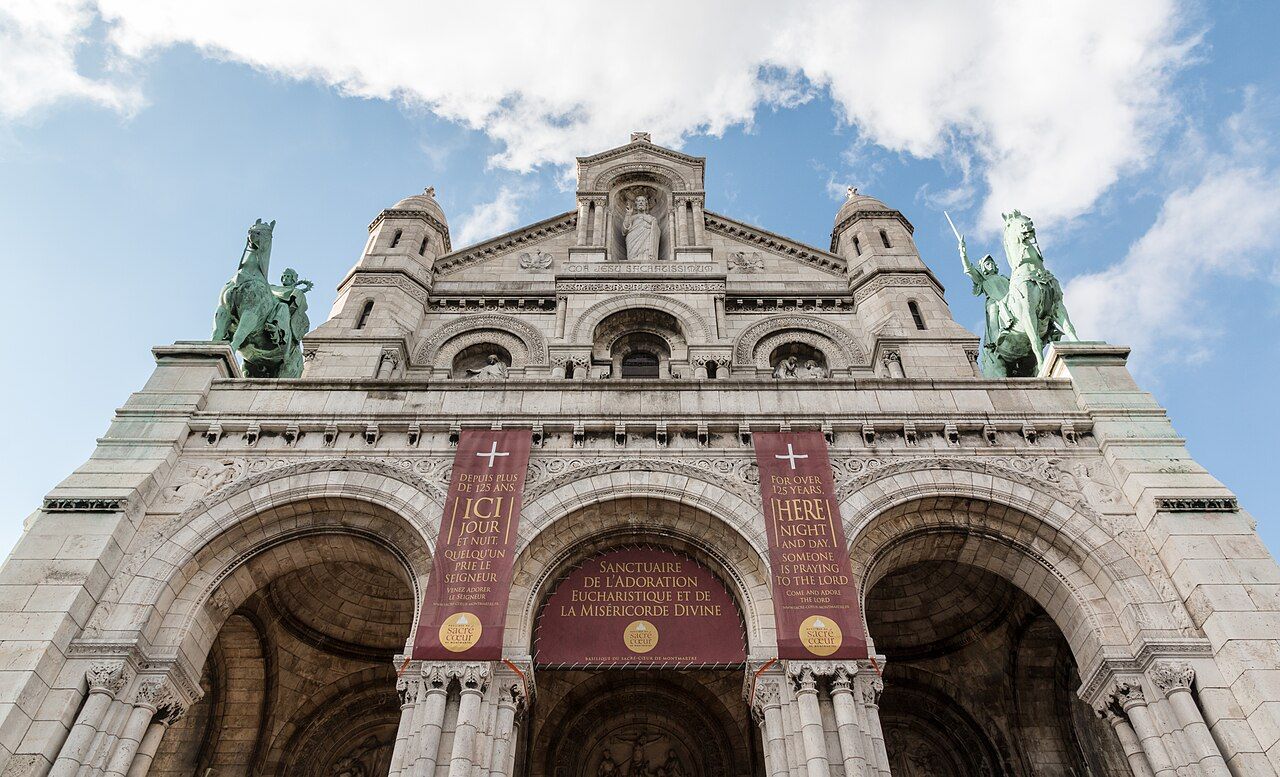 Dietmar Rabich • BY-SA 4.0
At Abbesses, an original glass-roofed Metro entrance starts the story. Designed by Hector Guimard, it gives you a first clue: Montmartre keeps its own character.
The numbers: about 130 metres; Metro line 12 to Abbesses.
The hill is Paris’s highest natural point. The village joined Paris in 1860, but its old centre still gives the climb a village-shaped plot.
Where does the climb begin?
Abbesses and Anvers are the two usual starting points. Abbesses is on Metro line 12; Anvers is on line 2. From Abbesses, climb towards the Sacré-Cœur, then continue to the Place du Tertre and the vineyard. The order matters: first the hill, then the square that belonged to the village.
For another walk among old Paris mansions, try a walk through the old Right Bank mansions.
What makes the Sacré-Cœur different?
The basilica was built between 1875 and 1914, then consecrated in 1919. Its stone comes from Château-Landon: travertine that whitens as it weathers. So the building’s changing colour is part of its material, not decoration added later.
The Montmartre funicular climbs the slope below the basilica. It takes a standard Metro ticket, so you can spare your legs that section. I’d keep the climb itself; the hill is the point.
Why stop at the Place du Tertre?
Before the village joined Paris, this was its main square. Pause there and the old village centre becomes more than a label: it explains why Montmartre feels distinct from the city around it.
Where does the vineyard fit?
The Clos Montmartre is a small vineyard planted on the hill in 1933. Each October, it is harvested during a neighbourhood festival. A vineyard inside Paris sounds like a punchline; here, it is simply part of the local calendar.
If you want one more stop, Montmartre Cemetery holds the graves of Stendhal and Edgar Degas. But you have already met the hill’s main argument: a village can join Paris and still keep its own square, vineyard and uphill attitude.
Paris got the hill. Montmartre kept the last word.
Photos in this piece: Benh LIEU SONG • BY 2.5; Jörg Braukmann • BY-SA 4.0; Myrabella • BY-SA 3.0