RegionÎle-de-France (Paris 3e-4e)By railMetro line 1 to Saint-Paul
The Marais on foot, square by square
Take the Marais slowly: from the Place des Vosges through aristocratic town houses, the Pletzl and free city museums.
 Diego Delso • BY-SA 4.0
The Place des Vosges gives you a square made for looking closely. Brick and stone repeat in a wonderfully steady rhythm. You can start there, then let the Marais unfold slowly. The district stretches across the 3rd and 4th arrondissements, on the Seine’s Right Bank.
The numbers: 3rd and 4th arrondissements; Metro line 1 to Saint-Paul.
The Marais takes its name from the French word for marsh. That name remembers the swampy ground beneath the district. It is a useful beginning: you are walking through a place whose shape carries its older story. Don’t rush past the details that make that story visible.
Place des Vosges
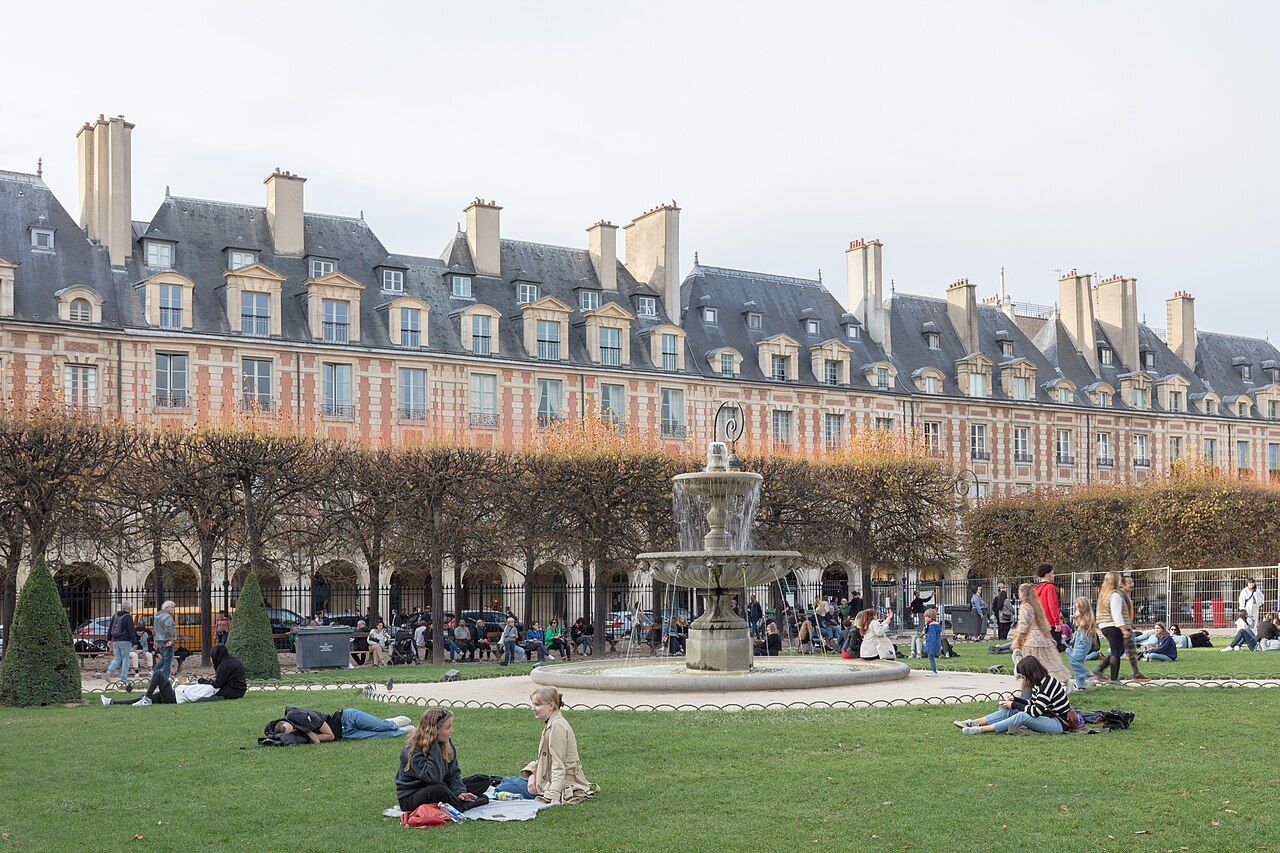
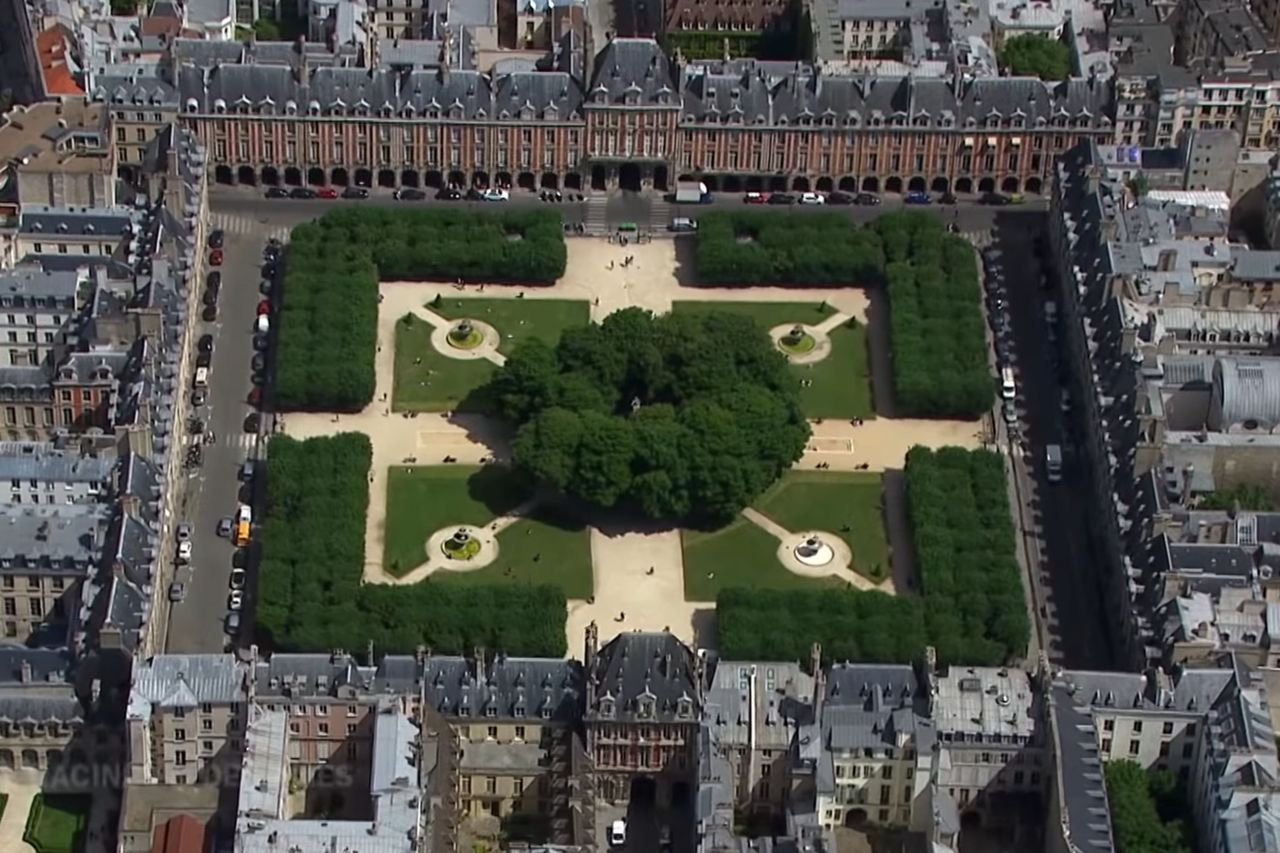
Morning. Start with the square, then walk its edges before crossing it. The Place des Vosges was inaugurated in 1612. It is the oldest planned square in Paris. Its geometry feels deliberate because it was.
Look along the facades rather than at one house alone. The square is lined by 36 houses of brick and stone. They follow a uniform design, so the whole perimeter reads as one joined composition. You can watch the repeated pattern do its quiet work.
Victor Hugo lived on the Place des Vosges from 1832 to 1848. His apartment is now a free city museum. That gives the square two kinds of history: the planned public space outside, and one writer’s home within it. You can pause on either side of that threshold.
You can read the Marais as a sequence of rooms outdoors.
 Des Racines et des Ailes • BY 3.0
You can read the Marais as a sequence of rooms outdoors.
The square makes a good first lesson in the district’s scale. You don’t need to hurry from one landmark to another. Follow the repeated brick and stone, then notice how a square can feel ordered without feeling empty. Keep the pace measured; the point is to see how each part sits beside the next.
Hôtels particuliers
Midday. Leave the square for the old aristocratic town houses. Many hôtels particuliers were built in the Marais in the 17th century. The name matters: these are town houses, not simply another row of ordinary homes. Their presence tells you who once shaped this quarter.
Walk square by square, letting the houses set your pace. The Marais is not one grand vista; it is a sequence of spaces and facades. You are looking at a district formed by marshy ground, then made legible through planned squares and aristocratic houses. That is the mechanism worth following.
In the 1960s, the Marais became a protected conservation area under the Malraux law of 1962. The protection gives the old fabric a present-day frame. You can think about that as you pass between the town houses and the lived-in streets: protecting the old fabric is part of the district’s story, not an optional footnote.
The route also invites comparison with the medieval student quarter across the river the medieval student quarter across the river. Keep that thought for another walk, though. Here, the older aristocratic houses and their setting hold your attention. If you want another market-focused wander, there is the oldest covered market in Paris the oldest covered market in Paris to connect with separately.
Rue des Rosiers
Late afternoon. Continue towards Rue des Rosiers, the heart of Paris’s old Jewish quarter. Its Yiddish name is the Pletzl. Let the change in name sharpen your attention: you are moving through the same district, but into another distinct layer of its identity.
 Gerda Arendt • BY-SA 4.0
Take this section without treating it as a box to tick. The Pletzl is not just another stop after the town houses. It gives the walk a different emphasis, and Rue des Rosiers is its centre. Give the street time to register before turning your thoughts back towards the museums.
The walk works best as a sequence, not a checklist. First, the planned square; then the aristocratic houses; then the Pletzl. Each part answers a different question about the Marais. What was built here, who made their homes here, and what names still mark the district?
Musée Carnavalet
The Musée Carnavalet is the museum of the history of Paris. It occupies two mansions in the Marais, and its permanent collections are free. That pairing is especially fitting after the walk: the district’s historic houses become the setting for a museum about the city.
Keep the museum stop simple. You have already spent the day reading the Marais outdoors. Now you can turn towards the city’s history through its permanent collections. Since they are free, there is no price to weigh against your curiosity.
The Centre Pompidou stands on the western edge of the Marais. It closed in 2025 for a renovation planned to last about five years. That closure is part of the district’s present story. You can note the contrast: conservation here, renovation there, and the Marais still organised around streets, squares and houses.
Metro line 1 stops at Saint-Paul, in the middle of the Marais. Use that as your simple rail marker, then keep the walking itself unhurried. This route asks for no heroic mileage. It asks you to notice the square, the houses, the names and the changes between them.
By the end, you have crossed a small geography with several histories. The marsh survives in the district’s name; the planned square survives in its repeated design. The town houses, Pletzl and museums give the walk its other chapters. Your feet may file a complaint about all those chapters; they can submit it in writing.
Photos in this piece: Maksim Sokolov (maxergon.com) • BY-SA 4.0; Dietmar Rabich • BY-SA 4.0; Benh LIEU SONG • BY 2.5