RegionGrand Est (Alsace)By railTGV from Paris Est, about 1 h 50
Strasbourg on foot: the Grande Île and Petite France
Walk Strasbourg’s island centre in a loop around the river Ill, from a cathedral clock to canal-side houses and the roof terrace above the Ponts Couverts.
 Dietmar Rabich • BY-SA 4.0
What does a river do to the shape of a city? In Strasbourg, the Ill makes its historic centre an island, and gives your walk a natural loop. Follow the city’s French and German accents through stone, clockwork and canals.
The numbers: TGV from Paris Est, about 1 hour 50 minutes.
Grande Île
Morning: begin on the Grande Île, Strasbourg’s historic centre on the Ill. The island is not just a handy way to organise your walk. In 1988, Strasbourg became the first city centre UNESCO inscribed in its entirety.
That wording matters. The listing recognises a city centre as a whole, rather than a single building. You can read the place at walking pace, with the river framing your route and the buildings supplying the detail. Keep the loop in mind; it gives the day a shape without turning the walk into a checklist.
The city’s story also refuses a simple French label. The Neustadt, built under German rule after 1871, joined the UNESCO listing in 2017. Strasbourg is the official seat of the European Parliament, too. Its identity gathers layers rather than choosing one neat accent.
Strasbourg Cathedral
Make the cathedral your morning anchor. Its spire, completed in 1439, rises to about 142 metres. From 1647 to 1874, it was the tallest building in the world. Those figures make the building’s ambition hard to miss, even before you start thinking about how long that title lasted.
Inside, give the astronomical clock your attention. Its present form dates from 1843. The useful pleasure here is the combination: a landmark measured against the sky, and a clock that turns time into something you can study. You do not need to rush from one to the other. Look up, then look closely.
 Syced • CC0
Midday: leave the cathedral behind and continue towards Petite France. The walk changes register from height and stone to water and working history. You are still following the same island logic, but the canals take over as the main guide.
Petite France
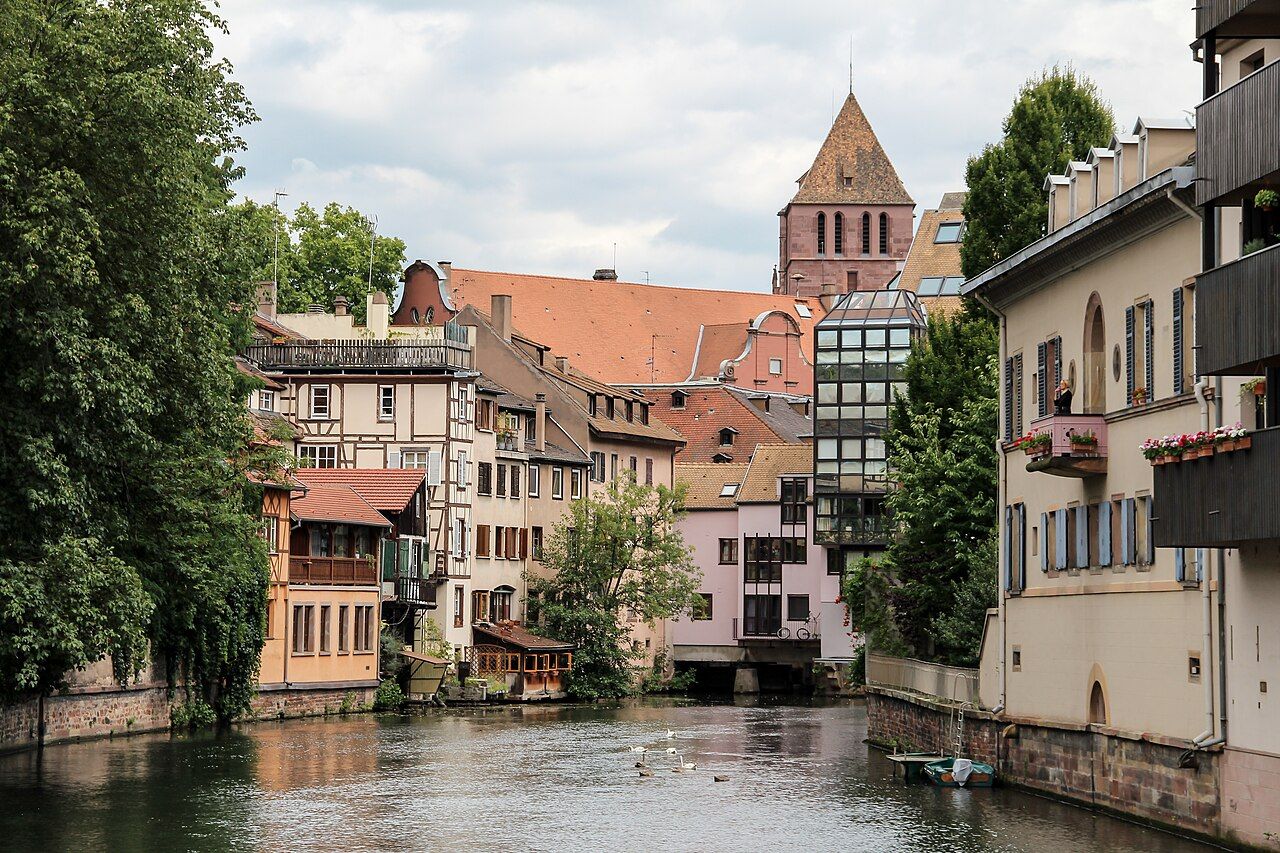
Petite France was the old quarter of tanners, millers and fishermen. Half-timbered houses stand along its canals. That pairing tells you more than a pretty façade can: water shaped the quarter’s working life, while the houses keep its street-level character in view.
Let the canals set your pace here. Watch how the buildings meet the water, and how the narrow channels make a different sort of city centre from the cathedral’s commanding height. Strasbourg’s mechanism is unusually legible: the Ill makes an island, and the canals give its old trades a setting you can still read.
If this walk has you thinking beyond Strasbourg, the wine-route town further south offers another contrast. For now, keep your attention on the water beside you. A loop works best when you let each part have its own character.
Barrage Vauban
Late afternoon: finish at the Barrage Vauban, a 17th-century weir with a roof terrace. From there, look over the Ponts Couverts. The weir makes the river’s role feel less like a border and more like city infrastructure: something built, shaped and put to work.
The terrace gives your walk a final change of viewpoint. You have moved from the cathedral’s spire to canals at street level, then upwards again over the river. It is a tidy way to close the loop, with Strasbourg’s layers gathered into one view.
Keep the route simple: island, cathedral, canals, weir, and back into the city. Strasbourg has enough history to make a long story; luckily, the river is better at going round in circles.
Photos in this piece: Gzen92 • BY-SA 4.0; Jebulon • Public Domain on Commons; Pline • BY-SA 3.0
